
For a comprehesive lesson on chords, including chord boxes, please see my Guitar 101 Chords lesson.
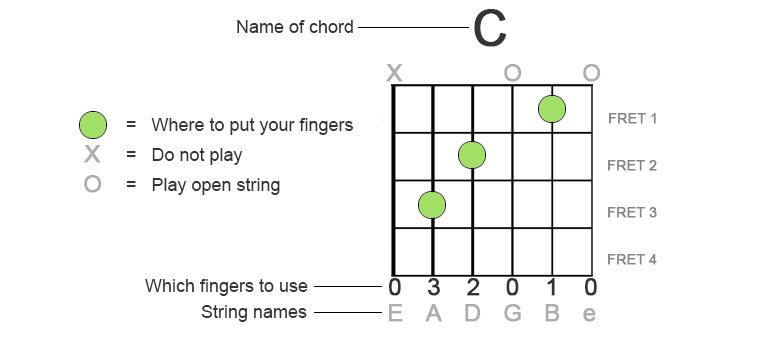
A chord box is a graphical representation of the first four (sometimes five) frets of a guitar neck as well as each of the six strings. Symbols are placed on the chord box that tell you which finger stops which string at which fret. Take a look at the following explanation of the C major chord box.
The modified chord boxes you will find in each song charts will look like this:
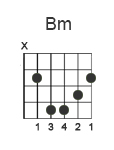
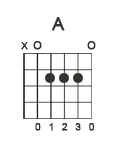
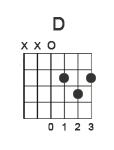
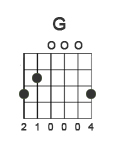
The charts are made up partly of what I call a "lyric layout". This is the part of the chart that maps out what chords are played throughout the verse, bridge, and chorus sections of the songs. Each chord reference is to be played for one measure, unless notated after the chord with a number in parentheses indicating how many measures it is to be played. In the first line below the A chord is played for two measures, followed by a single measure of A and then a single measure of E.
A (2)
But don't tell my heart, My achy breaky heart
A E
I just don't think he'd understand
E (2)
And if you tell my heart, My achy breaky heart
E A
He might blow up and kill this man
The lyric layout also gives you a general idea of where the chord changes are based on their position above the lyrics. In the lyric "I just don't think he'd understand", the A chord is played for one measure, with the change to E (next measure) occurring when the lyric reaches the word "understand".
In many songs that are parts where there are no lyrics or vocal melody lines, such as in intros, outros, and instrumental breaks between verses or during an instrument solo. These sections are represented by a modified music staff such as in the following example.
| E - - - | - - - - | - - - - | B - - - |
| B - - - | - - - - | - - - - | E - - - |
| E - - - | - - - - | - - - - | - - - - | (2)
The straight vertical lines represent the beginning and end of each measure. The letter at the beginning of each measure is the chord that is to be played for that measure. The dashes represent additional beats of the same chord. In the first line above, the E chord is played for three measures where it then changes to the B chord for one measure. On the second line the B chord is played for three measures where it then changes to the E chord for one measure.
The third line is an example of four measures of an E chord played twice through as indicated by (2).
For a comprehesive lesson on strumming please see my How To Strum lesson.
For a comprehesive lesson on tablature please see my Reading Tablature lesson.