
Strumming and strumming patterns are one of the main ingredients of rhythm. And it can be argued that rhythm is something that cannot be taught, rather you learn to feel and understand rhythm intuitively over time. Elvis Presley once said "Rhythm is something you either have or don't have, but when you have it, you have it all over." This may be true to a certain extent, but there are ways to effectively teach strumming patterns that allows you to practice the movements and get the "feeling" or intuition part of it down later.
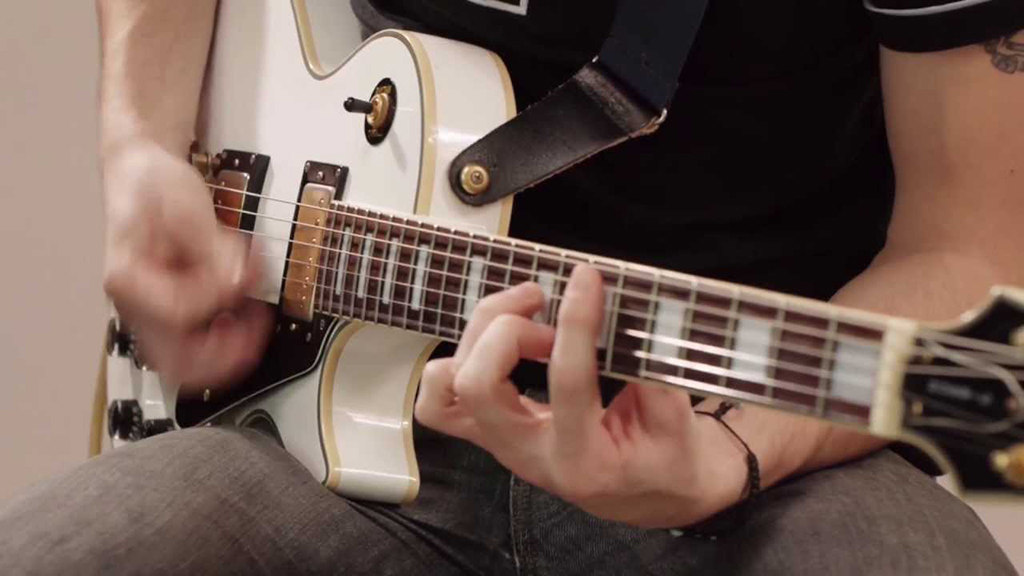
Our guitar 101 section on how to strum will introduce you to a variety of rhythmic patterns by briefly explaining time signatures, tempo, notes and note divisions, and pick stroke directions as they relate to strumming the acoustic and electric guitar. For a full understanding of these concepts, see my Intro To Theory lesson.
When we listen to a song, we almost subconciously tap our foot, clap our hands, or move some part of our body along with an unseen repetitive force. This driving force repeats itself over and over again at steady intervals and pushes the song along with a consistent timing. This is the beat of the song, and it is the most basic element of rhythm. This beat continues throughout the entire song, and occurs independent of anything else. It only has one job, and it is the one element of the song that all the other instruments follow.
A popular device that creates a steady consistent beat is called a metronome. It marks time at a selected rate of x beats per minute (bpm) and then produces a beep or tick at that rate to create a beat for you to practice or play along to. Here is an example of a metronome set to 60 beats per minute (one per second), and 120 beats per minute.
*Note: Each of the audio samples on this page features a click track provided by a metronome. In each sample, the clicks identify the main beats that fall on 1, 2, 3, and 4, at a tempo of 60bpm, with some providing a sample at 120bpm.
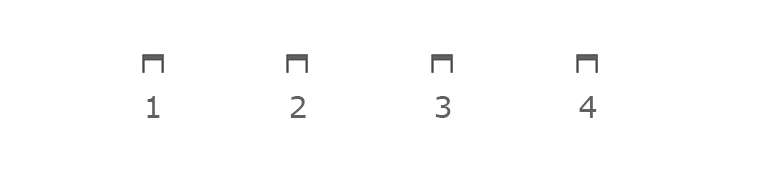
When you count along with the beat of a song it is common to assign numbers to each beat. The pattern of this numbering system is determined by what time signature is being used. A common 4/4 time signature means there are four beats per measure throughout the song. Because of this we only need to count four beats per measure, and then start over again on the next measure. Measures or bars divide the composition into smaller more manageable sections. If not for measures, standard notation and tablature would be very difficult to interpret, not to mention we would just keep on counting into oblivion.
In a 4/4 time signature the count would be in sections of fours: 1, 2, 3, 4, 1, 2, 3, 4, 1, 2, 3, 4, etc. The number of sections are determined by the length of the song. The best way to present this graphically is to simply write out the number of beats to represent a single measure.

Let's start out with the very simple, slow tempo, 4/4 strum pattern introduced above. This will give you a foundation strum pattern to build from. In this example we simply strum the chord repeatedly with a downstroke on each of the four beats. A downstroke is just as it sounds, you strike the strings with your fingers or with a pick using a downward motion. We learned about downstrokes and upstrokes in our lesson on reading tablature, and the symbols that represent them.

Let's apply the downstroke indicator to our sample strum pattern for more clarity. Listen to the accompanying audio sample of this strum pattern for more clarity. Each chord is played on the beat as a downstroke at a tempo of 60bpm.
The pattern is played twice. As it's playing count the beats as "1, 2, 3, 4, 1, 2, 3, 4".
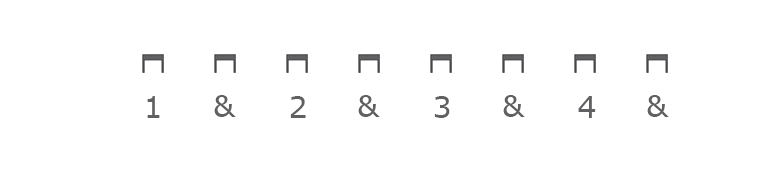
Let's add a downstroke between the beats. The main beats still fall on 1, 2, 3, and 4. The in between beats are vocalized as "and" as indicated by the ampersand symbol. This would be read as "1 and, 2 and, 3 and, 4 and", and as it is played be sure to use a downstroke on every beat, including the in-betweeners. As you can hear in the sample, the click track from the metronome will only provide a click on the main beats 1, 2, 3, and 4, not on the in-between parts.
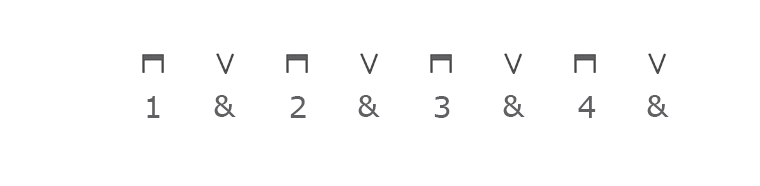
Combining downstrokes and upstrokes allows us to create a wide variety of acoustic strumming patterns. This is an economical way of using the returning motion of your hand after a downstroke, and it actually becomes almost necessary to execute strum patterns in this manner when the composition demands a faster tempo. Here are the symbols used in tablature to indicate stroke direction:

In the next example we need to make sure we are utilizing both a downstroke and an upstroke. We use a downstroke to attack the strings on the main beats 1, 2, 3, 4, but an upstroke on the "and" after each beat.
Listen to the accompanying audio sample of this strum pattern for more clarity. This will sound the same as the sample with all downstrokes, but as it's playing count the beats as "1 and, 2 and, 3 and, 4 and, 1 and, 2 and, 3 and, 4 and", making sure this time you are using an upstroke on the in between "and" parts.
Strumming the strings on every downstroke and upstroke can be difficult. There are many strum patterns that actually skip certain downstrokes and/or upstrokes. A good place to start learning about "creative" strum patterns is the so-called "Folk Pattern". This is a strum pattern where one downstroke and one upstroke are skipped. We will utilize the same eighth note pattern to demonstrate this. Skipping a strum means your downstroke or upstroke in that instance would go past the strings and not touch them.

You can imagine the variety of strum patterns that are possible considering the vast amount of note divisions available.
In this introductory lesson on strumming we've covered all the necessary concepts to get familiar with basic strumming patterns. Conceptually we've gone over some theory, along with an explanation of the steps necessary to apply that theory, but to get a clear understanding of music theory, check out the Guitar 101 Music Theory lesson.