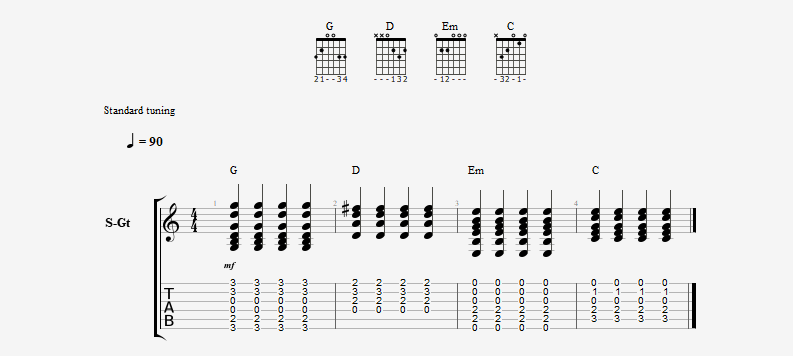
Music theory is the study of music and its constructive elements. Guitar theory is music theory as it applies specifically to the guitar. Typically, this includes information that enables guitarists to understand the fretboard, chords, chord shapes, scale patterns, chord progressions and relationships, note positions, intervals, keys, modes, harmony, and scale applications. In our intro to theory we will discuss these basic building blocks.
Notes are the building blocks of music. A note can be thought of as the pitch or seeming highness or lowness of a sound. All music is made up of notes, and all notes are given a letter name taken from the musical alphabet. The musical alphabet is made up of 7 letters A through G, each representing a natural note. This A through G sequence repeats itself when it reaches the end. This means after the musical alphabet reaches the letter G, it repeats the same set of A through G at a higher pitch. The distance between each same-note pair (i.e. A to A) is called an octave.

No matter what note you start on, the musical alphabet will end at G and return to A, as shown in the following two octaves starting on D.

Notes can be further broken down into one of three types: flat, natural, or sharp. Let’s use the note A to examine these types. When the A note is played in its natural position, it is referred to as A natural. A half-step, or one fret below A natural gives us an A flat, and a half-step or one fret above A natural gives us an A sharp.

These flats and sharps are called accidentals, and they change the pitch of the note. A flattened note will go down in pitch, while a sharpened note will go up in pitch. There are special symbols to indicate a flat, natural, or sharp note as shown in the image. The flat, natural, and sharp symbols go after the note. Let's look at this relationship on the fretboard. The image shows the 5th fret E string natural location of A. A half-step below A you will find A flat (4th fret, E string), and a half-step above A you will find A sharp (6th fret E string).

*Note: Moving up the neck (towards the bridge) sharps the note. Moving down the neck (towards the head) flats the note.
When you add the sharps and flats into the musical alphabet, you will notice there are a more notes than just the seven notes A through G. The seven letters of the musical alphabet represent all of the natural notes. Let’s look at the additional accidentals by adding in the sharp notes.

We actually end up with 12 notes by adding 5 extra sharp notes. What about the flats? Where do those fit in? Let’s take a look at the musical alphabet with flats instead of sharps.

We still end up with 12 notes by adding 5 extra flat notes. Let’s look at the musical alphabet with both sharps and flats. Each 12-note sequence of natural and accidental notes is known as the chromatic or 12-tone scale.

You’ll notice that there are 5 sharp and flat note pairs, and each pair occupies the same location in the musical alphabet. Therefore, the sharp and flat note in each pair will both produce the same note. For example, A sharp and B flat occupy the same location on the fretboard and therefore produce the same pitch. You will also notice that not all notes are designated as a sharp or a flat. There is naturally no sharp or flat note between B and C, and E and F.
The distance between any two notes is called an interval. The smallest interval in musical notation is a half-step, also called a semitone. A whole-step is a combination of two half-steps. Half-steps and whole-steps are combined into patterns to create scales and modes, and ultimately, unique harmonies and melodies.
Mapping half-steps and whole-steps on a guitar is easy. Each fret on a guitar is a half-step. Choose a starting fret. Moving that position up one fret is a half-step. Moving that position down one fret is also a half-step. A two-fret interval on the guitar is a whole step. Choose a starting fret. Moving that position up two frets is a whole-step. Moving that position down two frets is also a whole-step.
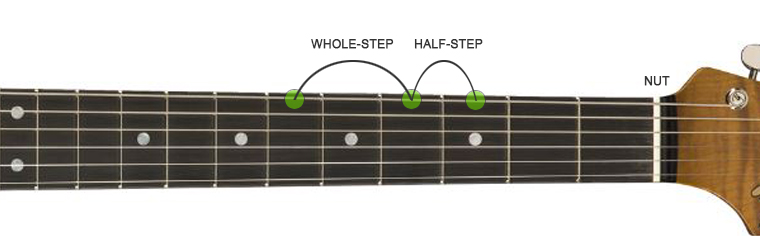
*Note: Remember, moving up the neck (towards the bridge) sharps the note. Moving down the neck (towards the head) flats the note.
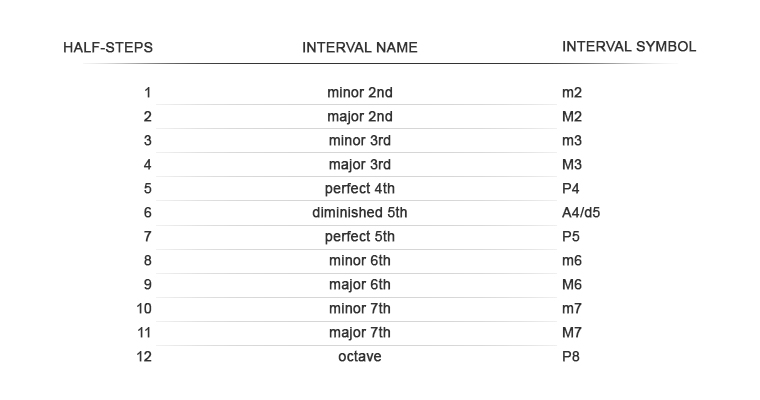
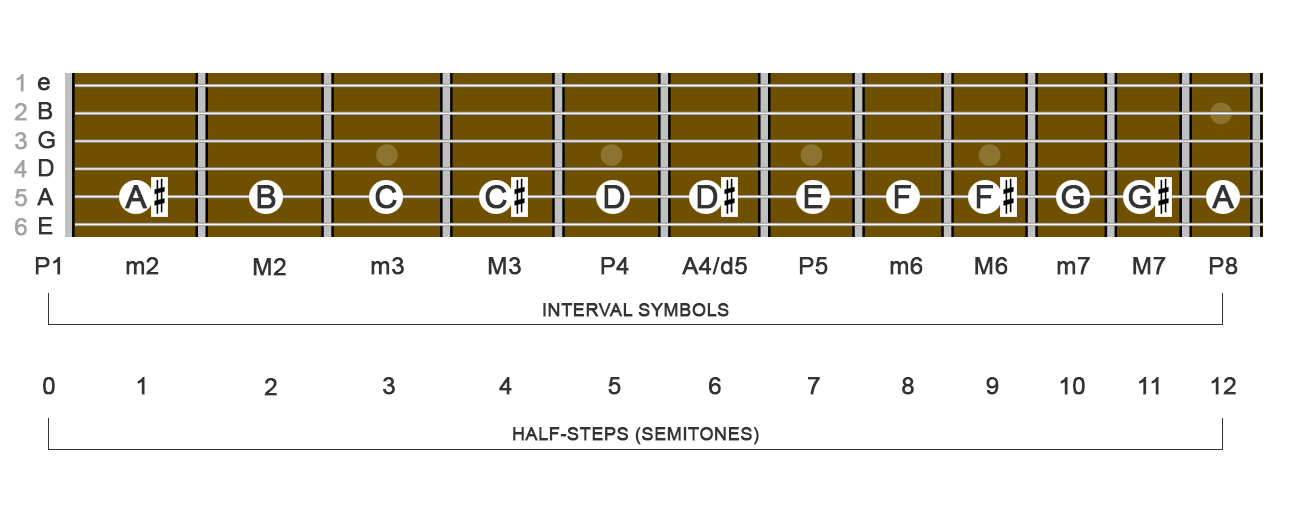
Let's dig into intervals a bit more and learn about how to use the half-step as a constructor of intervals. As there are 12 notes in the chromatic or 12-tone scale, so are there 12 intervals. Understanding intervals is the key to creating scales, chords, arpeggios, etc. Intervals are the distance between any two notes. On the guitar the smallest distance is a single fret, or a half-step, and half-step counts can be used to determine intervals and interval names. For example, moving a distance of 4 frets from any starting note on the guitar is a combination of 4 half-steps. This 4-fret/4 half-step interval is called a major 3rd. Let's look at all 12 simple intervals.
The following highlights a full octave starting with the open A or 5th string.
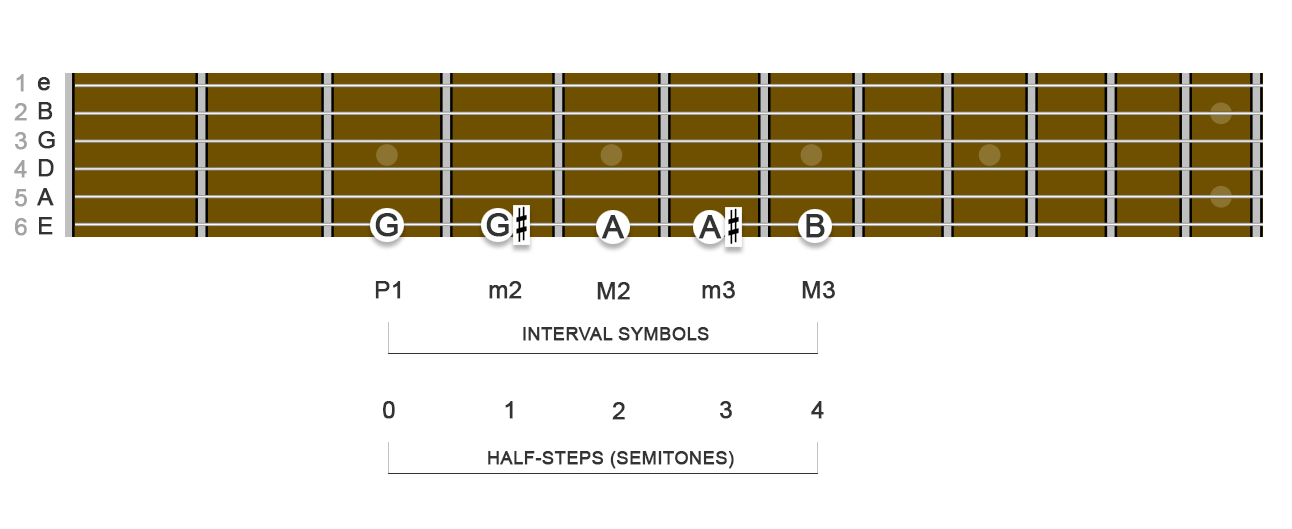
Let's take a look at a single interval for more clarity. The following shows a major 3rd interval, which is comprised of 4 half-steps starting at the 3rd fret on the E or 6th string. This is the note G. Four half-steps up from G is the note B (G-G#, G#-A, A-A#, A#-B). Four half-steps is also two whole-steps.
Intervals can span multiple strings, not just the linear, single-string intervals we have seen here. Let's take a look at whole-steps and half-steps and their relationships between adjacent strings. Knowing multiple interval options across the fretboard will greatly aid in your understanding of scales and chords. Let's introduce this concept by first revisiting the fact that notes exist in multiple locations across the fretboard. The following shows several locations for the note B.
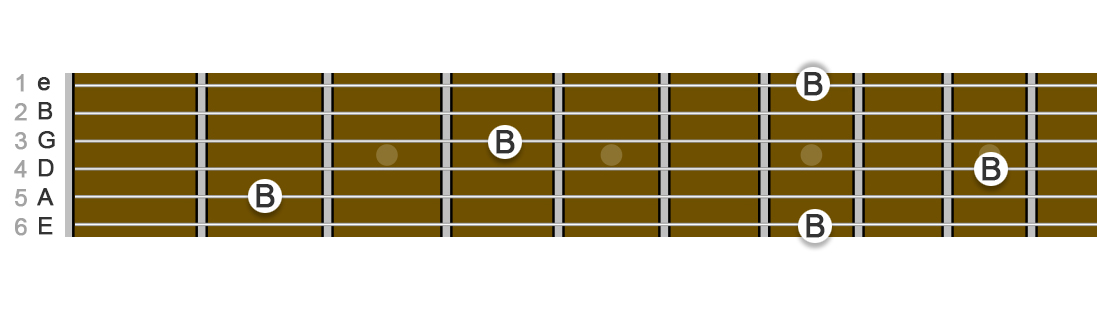
Knowing that there are multiple locations across the fretboard also leads us to the fact that there are several interval relationships across the fretboard. Each of the B note locations in the following example are shown advancing up the fretboard by one whole-step (two frets), thereby creating Major 2nd intervals in multiple locations.

Knowing that there are multiple note and interval locations across the fretboard helps us to understand that moving a whole step from B, 7th fret on the E/6th string, to C#, 9th fret on the E/6th string, is the same as moving from B, 7th fret on the E/6th string to C#, 4th fret on the A/5th string. The starting note, B is the same in both intervals. The C# note in both intervals is also the same, just at different fretboard locations.

A half-step interval across adjacent strings from B to C, would look like this.
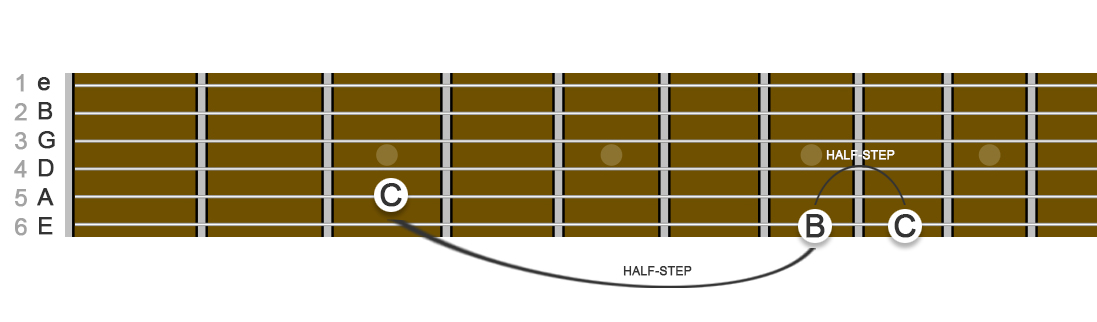
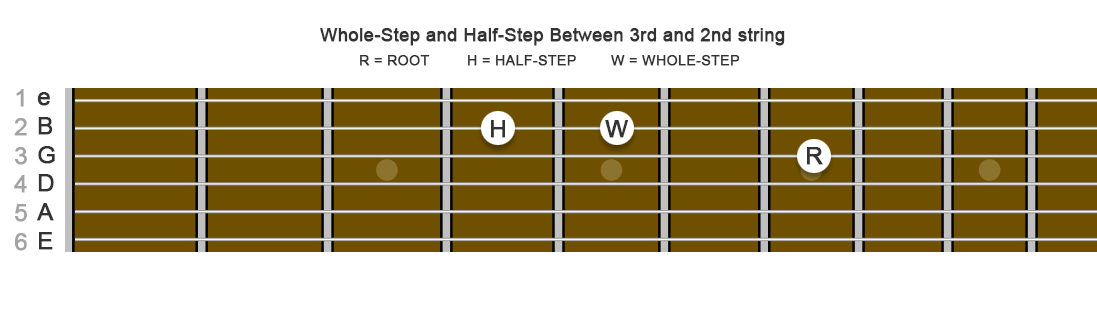
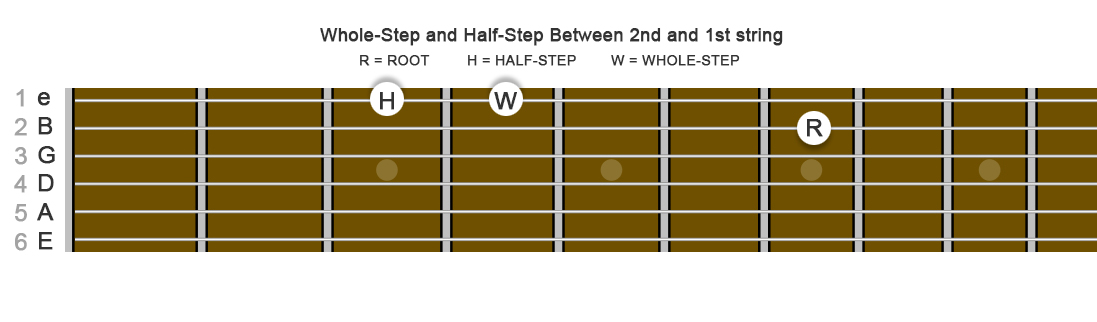
Ok, let's take a look at all the adjacent string half-step and whole-step interval relationships.
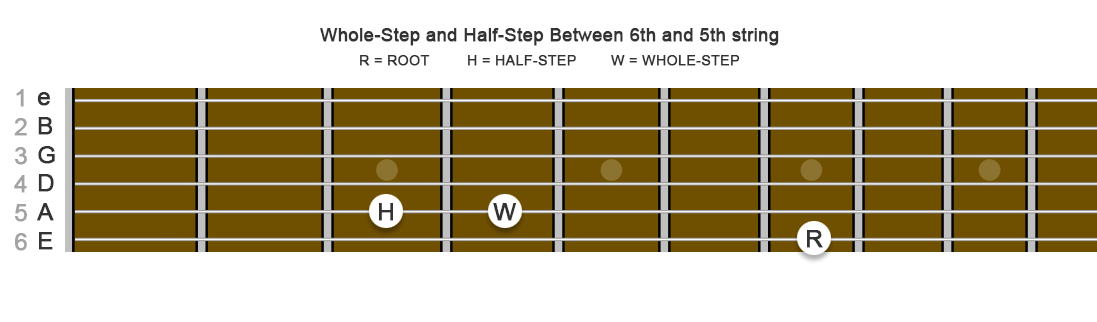
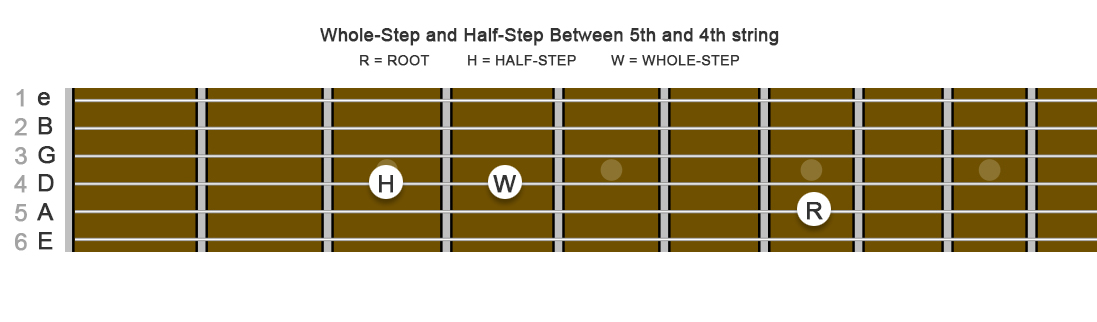
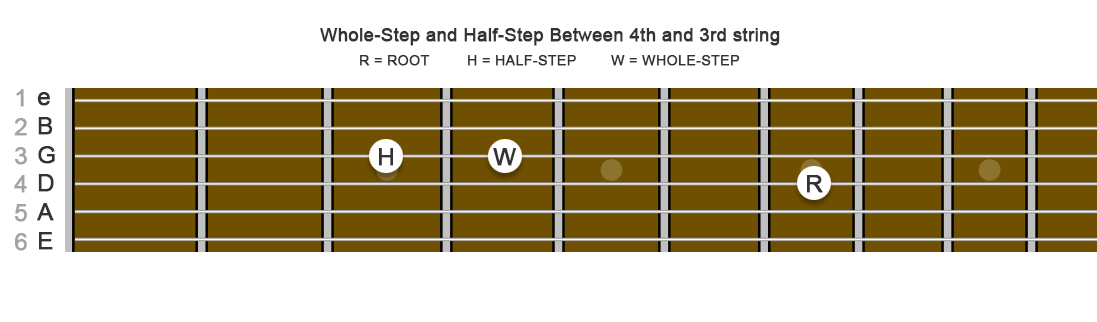
Because the B string is tuned differently in relation to the G string, we have to compensate by adjusting the relationship on the fretboard for the 2nd and 3rd strings.
Scales are constructed using the musical alphabet and a unique pattern of whole-steps and half-steps. Scales are one of the first steps towards learning lead guitar melodies. There is a wide variety of musical scales. We will touch on the most popular ones, and also discuss scale degrees. A scale can start from any note. For simplicity, our examples will all begin with natural C. The first scale we will introduce is the major scale.
The following is the whole-step and half-step pattern that defines a major scale. W = whole-step, H = half-step.

A whole-step is labeled as "W" and a half-step is labeled as "H". What this means is starting with C, there is a whole-step up to the next note in the scale. Followed by another whole-step to the next note. Then a half-step up to the next note. The following will exemplify this. This is the C major scale.

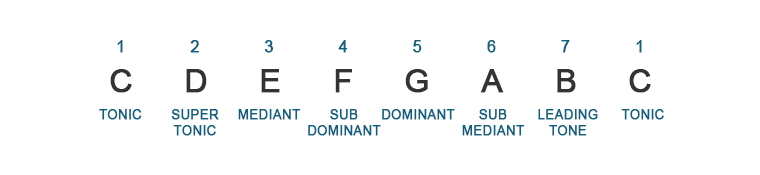
Let's take a moment to learn about scale degrees. Scale degrees refer to the positions of notes in a scale relative to the starting note. In our example the starting note is C. The scale degree is the number given to each step of the scale, starting with 1. They can also be identified by names: tonic, supertonic, mediant, subdominant, dominant, submediant, leading note/tone, and tonic again. These terms and their uses will come into play as you advance your knowledge of theory. We will leave it at this for now.
The musical alphabet sequentially starting with C naturally fits the major scale pattern. The natural half-steps between E and F, and B and C fit perfectly into the required half-step intervals between the 3rd and 4th, and 7th and 8th scale degrees. Let's look at the C major scale mapped on the fretboard. Remember, a half-step on the fretboard is a single fret, and whole-step is two frets. You can see there is only a distance of one fret from E to F and from B to C, so starting a major scale on C works out nicely due to the notes falling perfectly into the major pattern.

Starting from any other note in the musical alphabet will require the use of accidentals in order to maintain the major pattern. Accidentals are another name for sharps and flats. Let's explain this further, by starting our major scale on A.
First let's plug the notes into the pattern sequentially from A to its first octave.

The notes do not fit nicely into the major pattern like they did when starting on the note C. The first thing we notice is that there is not a required whole-step between B and C. Remember from our fretboard that there is only a single fret distance from B to C, so that is a half-step, not a whole-step. In order to make the distance between B and C a whole-step, so it fits into the major pattern, we have to increase the distance between them by on fret. We do this by making C a C#.

The distance between B and C# is now a required whole step, and subsequently the distance between C# and D is now a required half-step, which both now fit the major pattern. The next problem we see is that the notes E and F do not follow the major pattern. There should be whole step between them, but there is naturally only a one fret difference, or half-step between these notes. In order to make the distance between E and F a whole step, so it fits into the major pattern, we have to increase the distance between them by one fret. We do this by making F a F#.

By doing this we have created another problem with our pattern. What used to be a whole-step between F and G is now a half-step between F# and G. This violates our major pattern. Also the distance between G and A needs to be a half-step, not the whole-step that it currently is. We can solve our last two pattern problems with a single change. Make G a G#. Now all of our notes fit neatly into our major scale pattern.

Let's take a look at another popular scale pattern, the minor scale. The following is the whole-step and half-step pattern that defines a minor scale. W = whole-step, H = half-step.

The A minor scale naturally fits this pattern because of the natural half-steps between B and C, and E and F. You can see there is only a distance of one fret from B to C and from E to F. Starting a minor scale on A works out nicely due to the notes falling perfectly into the minor pattern.

Remember, a half-step on the fretboard is a single fret, and whole-step is two frets. Let's look at the A minor scale mapped on the fretboard. In this example the first note, A is the open A or 5th string. It follows the minor scale pattern with half-steps between the 2nd and 3rd scale degrees B and C, and the 5th and 6th scale degrees E and F.

As with the major scale, starting the minor scale on any other note except A will require the use of accidentals on the appropriate notes to maintain the whole-step half-step pattern.
The examples above show the scale in a linear fashion on a single string to highlight the whole-step and half-step relationships. Let's take a different approach to visualizing the major and minor scale on the fretboard, by mapping it across all the strings. We have learned that intervals can be mapped across adjacent strings. By doing this, the scale can be visualized and played much easier than on a single string.
Let's look at the G major scale. The scale begins on the 3rd fret of the E or 6th string, this is the note G. Following the major scale pattern, the next note is a whole-step, or two frets above G, which takes us to the 5th fret E/6 string. This is the note A. The next interval is also a whole-step. If we were mapping in a linear fashion the next note would be a whole-step, or two frets up from A, which would take us to the 7th fret E/6 string. This note would be B. But, we are mapping across all the strings, so instead of continuing up the fretboard, our next note is found on the 2nd fret of the A/5 string. This is also the note B.
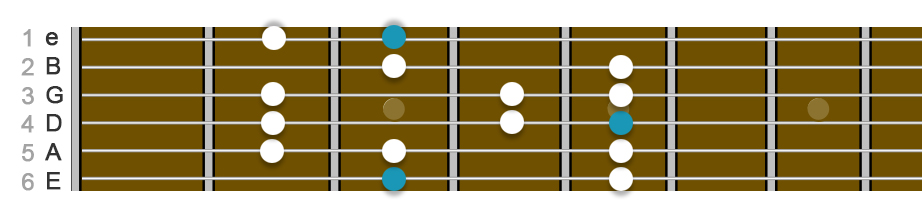
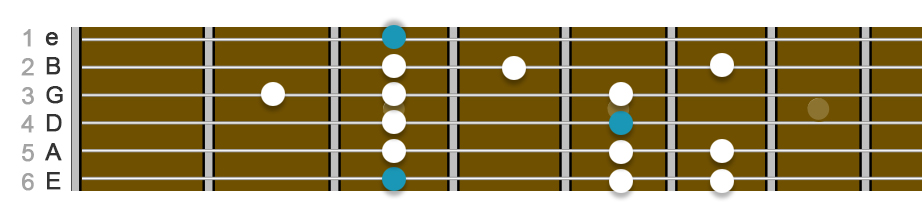
The major pattern above is mapped at the G major position. This pattern can be moved up and down the fretboard. The pattern does not change, where it is mapped on the fretboard determines what note the scale pattern starts on. If we moved it up a whole step, we would have an A major scale mapped. Let's do the same with the minor scale pattern applied to G.
Chords are constructed using a combination of harmonic intervals. The distance between the notes that make up the chord, determines the type of chord. Chords are identified by unique names which consist of the chord root and then the type of chord.

Determining the root note is simple, because it's in the chord name. The type or quality of the chord requires a bit more understanding.
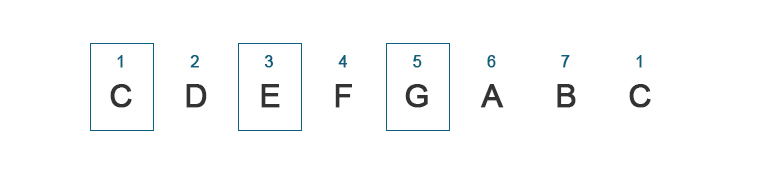
Just as there are patterns that govern major and minor scales, there are patterns that can be used to discover the notes that make up a chord. Let's consider a C Major chord. We know the root of the chord is C, and we know we are looking for the notes that make up a major chord, so we simply map out the scale that the chord is based on, C major.

We then apply a simple pattern to discover the notes that make up the C Major chord. For a major chord the pattern is 1-3-5. These numbers correspond to scale degrees, and in the case of the C major scale, the notes at the 1, 3, and 5 scale degree locations are C-E-G. This is known as a major triad.
If we wanted to map out a G major chord, we would follow the same process using the G major scale as our starting point, resulting in G-B-D as our major triad.

Here are the triads as mapped on our fretboard. In both cases the 5th is provided by an open string.
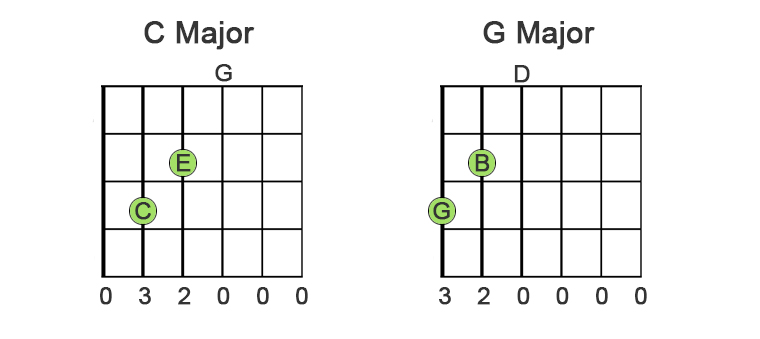
It is important to note that most chords do not stick to just playing the triad. Most chords double some or all of the notes of the triad in the higher octaves to create a more "full" sound.
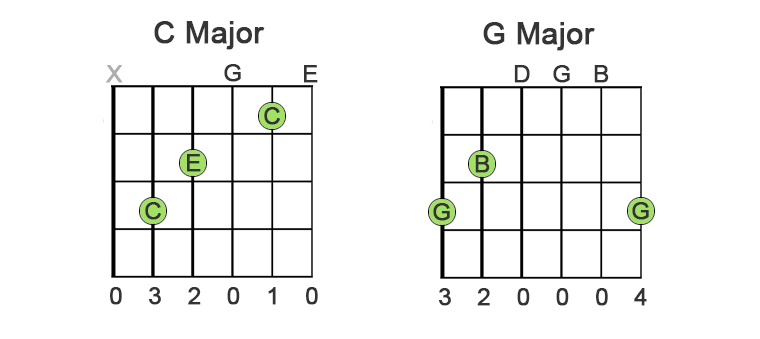
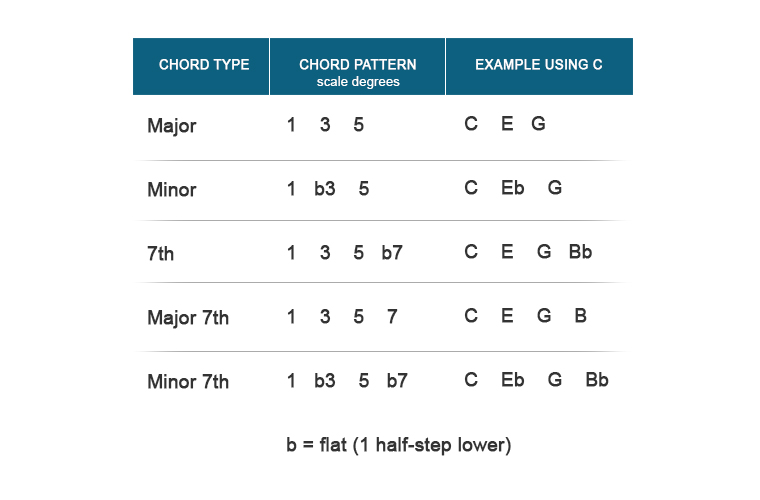
So, the process is quite simple.
A musical key can be loosely defined as a collection of chords and scales that form the foundation of a musical composition, or song. The collection of chords are taken from the scale degrees of the major or minor scale in which the key is based. For example, let's consider a composition in the key of C. To determine the chords that exist in the key of C, we first write out the C major scale.
Each scale degree is the root note of a chord. For example, the first scale degree, C or the tonic, is the root note of a C major chord. The second scale degree, D or the supertonic, is the root note of a D minor chord. Just as there is a pattern of whole-steps and half-steps to determine scale types, there is also a pattern that determines chords for those scale types. Using the major scale pattern, the chord pattern is as follows:

Remember our discussion on chord construction and how chords are a combination of intervals. Mapping those intervals across a major scale determines the chord types derived from each scale degree. Applying the chord pattern to the C major scale gives us the information we need to determine the chords available in the key of C.

There is a way to combine scale degrees with chord types. Scale degrees are just the numerical location of each note relative to the starting note, and the chord pattern is made up of major, minor and diminished designations. We can combine this information into a written representation of both using roman numerals. The roman numerals for 1 through 8 are shown below.

Using capital and non-capital roman numerals represents major and minor respectively.

Mapping this system onto our major scale now reveals both the scale degree positions and the type of chords for that position.

Therefore, the chords available in the key of C are C Major, D minor, E minor, F Major, G Major, A minor, and B diminished. *Note: the diminished chord is rarely used in compositions.
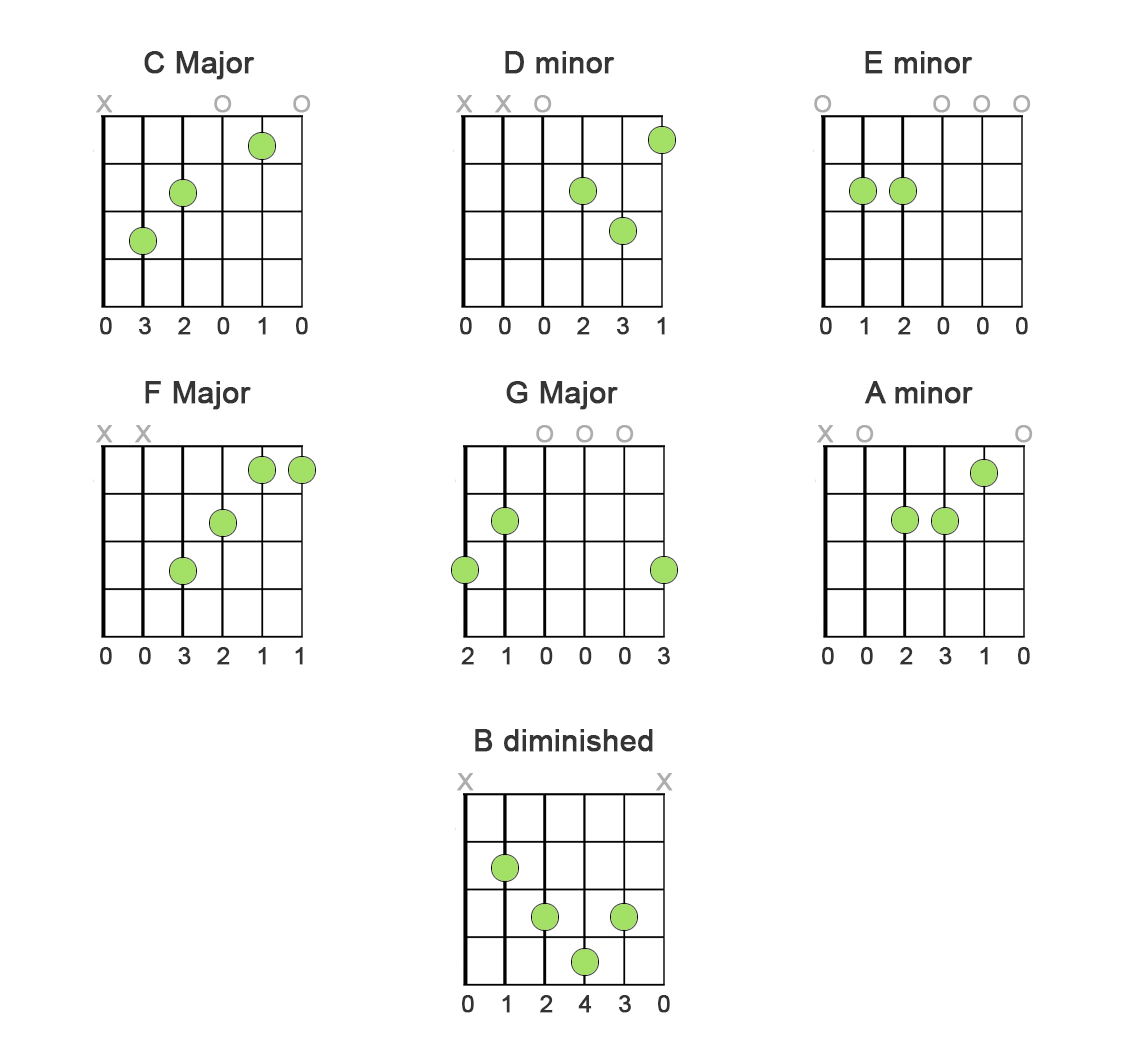
What does this mean from a performance perspective? Basically it means that this collection of chords work well together when used to create a composition in the key of C. If you stick to these chords, and playing melodies based on the C major scale, you can't go wrong. It will simply sound "right". Let's listen to the above major and minor chords in the key of C, played in order and then reverse order.
A chord progression is often used when describing the chords used in a song. Most songs are made up of a collection of chords, played in a specific order, and in a repeating pattern. How is is determined which chords are to be used in a song and in which order should they be? Which chords sound nice together and why?
As we learned in the section above on musical keys, it is the key that determines the collection of chords and scales that are used to create the composition. The chords that are present within the key are played in a specific order and often in a repeating manner throughout the song. These chords and the order in which they are played, or progressed through, is known as a chord progression. The number of ways you can combine chords is nearly endless. Although there are no hard and fast rules as to what chords you can and cannot combine there are some tried and tru methods to determine chord selection.
Chord progressions are most often written using a notation that reveals the chords root scale degree. For example, a I-IV-V progression is a way to notate the 1, 4, and 5 root scale degrees using roman numerals, and is arguably the most common representation. So, what does a I, IV, V chord progression mean? Let's take a look again at scale degrees.
We have already learned how to construct chords from scale degrees, so determining the chords used in a I-IV-V progressions should not be a problem. We simply construct our chords at the 1, 4, and 5 positions of the scale. For the C major scale the I or 1 chord would be C-E-G.
The IV or 4 chord would be the triad starting at the 4th scale degree. In the C major scale that would be F-A-C
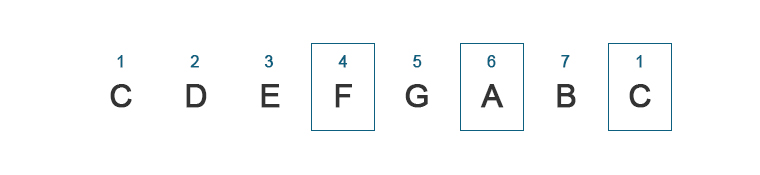
The V or 5 chord in the C major scale is G-B-D, the triad starting at the 5th scale degree. We had to sneak up into the next octave for this one.

Remember the major-minor-diminished chord pattern that is applied to a major scale to determine chord types? All of the chords in the I-IV-V progression are major chords, which gives a composition written with this progression an upbeat happy sound. Major chords are most often associated with this type of mood. So, a I-IV-V progression in the key of C would utilize the following major chords.
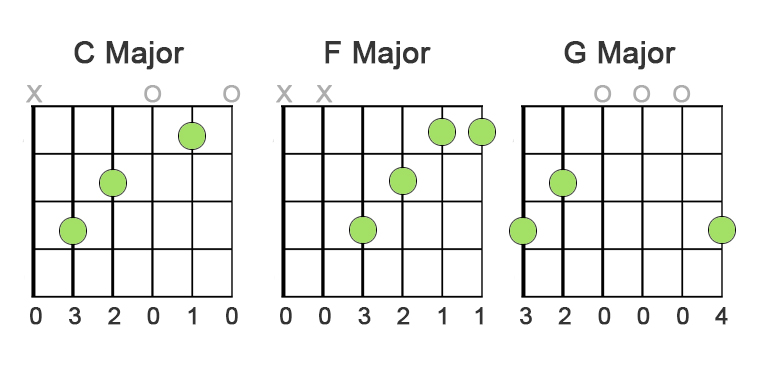
The I-IV-V chord progression is considered the foundation of classic rock. It was used extensively on the vast majority of songs of the 60's and 70's. Arguably the most popular chord progression in western popular music is the I-V-vi-IV. Let's use the key of G to examine this one. The I chord is easy.
The V chord is derived from the triad starting at the 5th scale degree. We need to hop into the next octave to complete the triad.
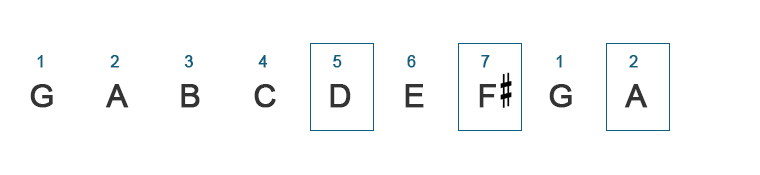
The vi chord is derived from the triad starting at the 6th scale degree. This chord is minor. Remember the pattern applied to the major scale to determine chord types? The chords at the 2, 3, and 6 scale degrees are minor chords.
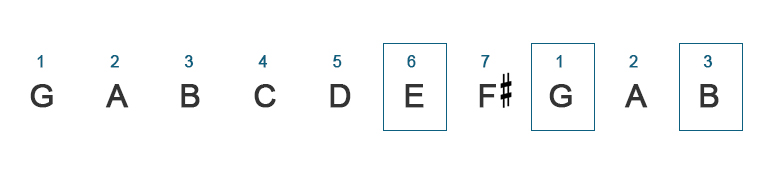
The IV chord is derived from the triad starting at the 4th scale degree. This is a major chord.
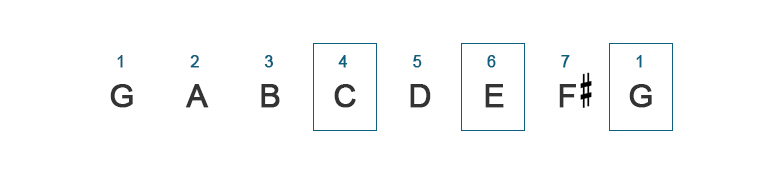
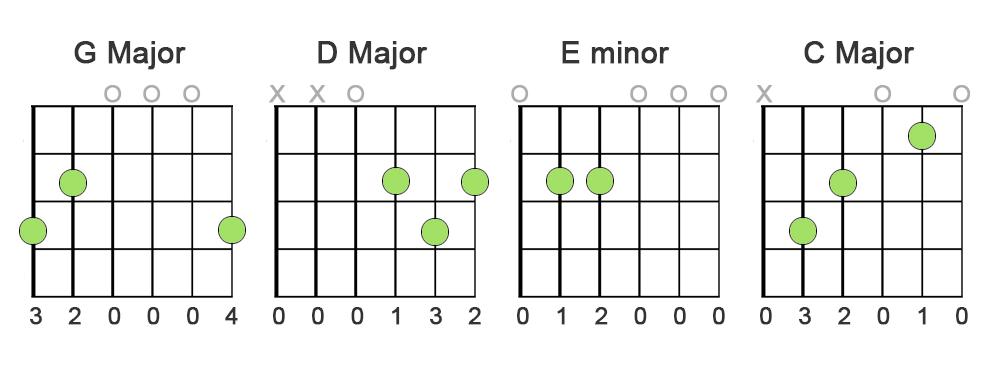
So, the I-V-vi-IV chord progression uses the following chords.
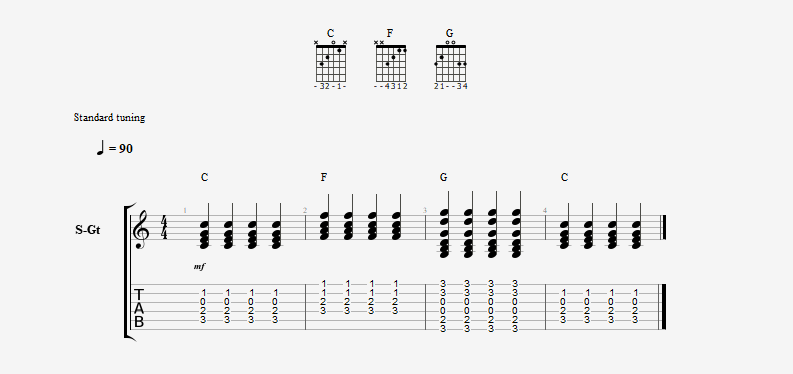
Let's take a look and listen to these two chord progressions and what they sound like. First, the I-IV-V chord progression in C Major.
Now, the I-V-vi-IV chord progression in G Major.