

Understanding the fretboard will be of great benefit to you as you learn the relationship between the strings and frets, and the notes that are created when you combine the two. This knowledge will be invaluable when it is time to dive into melody and harmony, chord voicings, chord progressions, and lead guitar heroics!
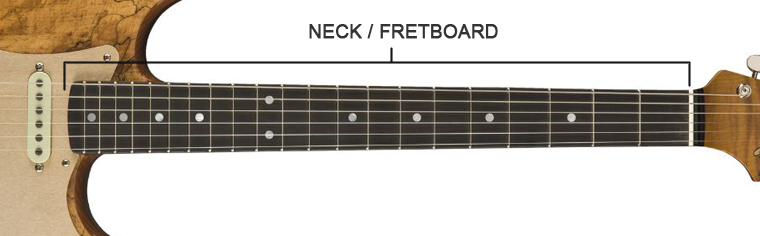
The Neck and FretboardLet's expand on the anatomy of the guitar and learn about the neck and the fretboard. The neck of the guitar is covered with a fretboard, made of a long strip of laminated material, usually a type of wood. The strings run the length of the guitar from the nut to the bridge as they pass over the fretboard.
FretsDo you see those metal wires that run perpendicular to the neck creating little boxes up and down the fretboard? Those metal wires are called frets, and they divide the neck into fixed segments at intervals that determine the positions for the correct notes. Think of them as guides when determining which notes or chords you would like to create.
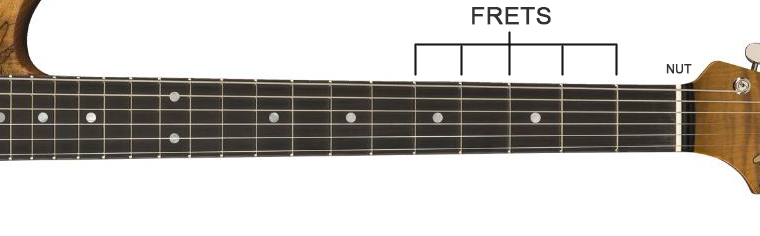
The word fret is often used as a verb, meaning simply "to press down on a string against the fretboard". Frets make it much easier for a player to achieve an accurate pitch, since the frets determine the positions for the correct notes. *See Fretting below.
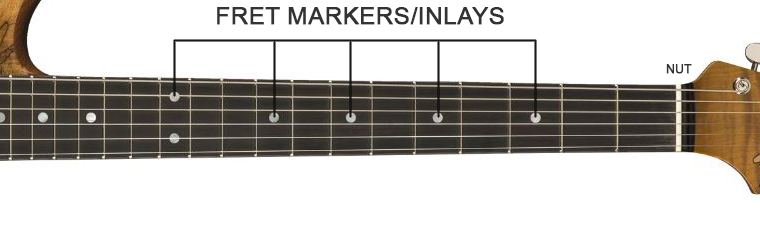
InlaysInlays expand on the fretboard guidance system by marking some of the spaces between the frets for quick identification when navigating the instrument. These inlays come in a variety of designs, but traditionally a simple dot is used. The inlays traditionally mark the 3, 5, 7, 9, 12, 15, 17, 19, 21, and 24 fret locations.
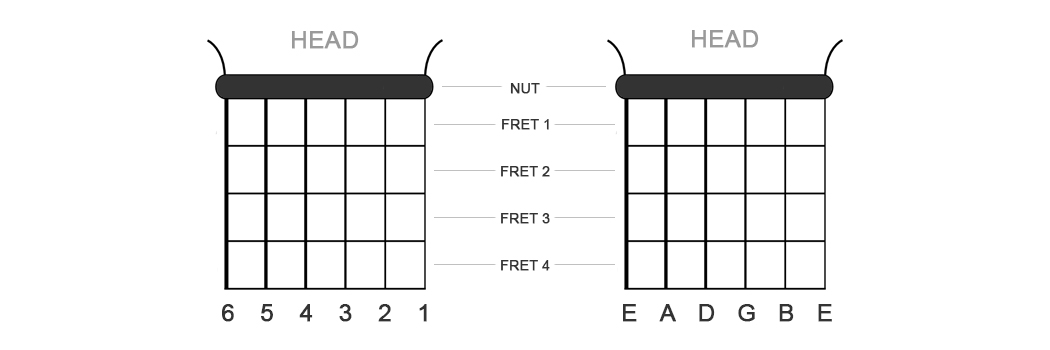
String names and numbering systemThere is a system to identify the strings and frets of your guitar. This will be very important when it comes to reading tablature, fretting chords, and playing melody lines. The strings are each tuned to a unique pitch or named note, and common standard tuning determines the names of these notes.
The following explanation assumes you are holding your guitar as taught in the Holding A Guitar lesson. The strings are numbered 1 through 6 with the #1 string being the one closest to the floor, and it is the thinnest of the 6 strings. The #6 string is the one farthest from the floor, and it is the thickest of the 6 strings. Identifying the strings from lowest to highest the named notes for the strings are E A D G B and E, with the lowest being the 6th string at the top of the fretboard and the highest being the 1st string at the bottom. These note names are the notes that are created when plucking the strings without fretting the board. This is called an open string. For example, plucking the the 6th string open will produce an E note. The frets are numbered 1 through the highest fret on your guitar (20, 22, 24, etc.) starting at the nut. Check out this wonderful video from Berklee Online to learn more about the string names and numbers.
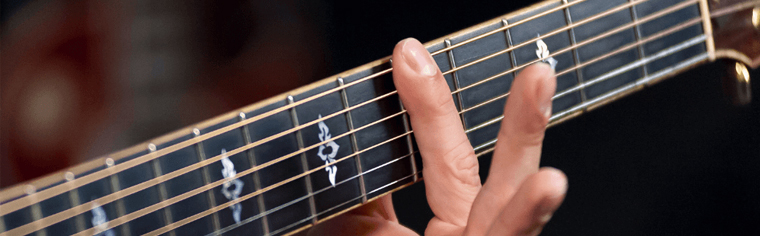
FrettingTo play the instrument, you press down on a string against the fretboard to change the vibrating length of the string and thereby create notes of varying pitch. This is called fretting, or stopping the strings. When fretting a note, a player presses down on the string behind the fret, not on the fret itself. This has led the vast majority of guitar players and teachers to refer to the space between the frets as frets. The image shows the player "fretting" the instrument at the 5th fret of the E or #6 string.
Notes are the building blocks of music. A note can be thought of as the pitch or seeming highness or lowness of a sound. A note can also be thought of as the written representation of the pitch. The musical alphabet is made up of 7 letters A through G. The sequence repeats itself when it reaches the end of the musical alphabet. This means after the musical alphabet reaches the letter G, it repeats the same set of A through G at a higher pitch. The distance between each same-note pair (i.e. A to A) is called an octave.

As mentioned in the basic fretboard section above, the string and space you choose to fret on your guitar will determine the note you are playing. Each note can be further broken down into one of three types: flat, natural, or sharp. Let’s pick a note to examine these types. Let’s use the note A. When the A note is played in its natural position, it is referred to as A natural. A half-step, or one fret below A natural gives us an A flat, and a half-step or one fret above A natural gives us an A sharp.

These flats and sharps also change the pitch of the note. A flattened note will go down in pitch, while a sharpened note will go up in pitch. There are special symbols to indicate a flat, natural, or sharp note as shown in the image. These symbols go after the note. Let's look at this relationship on the fretboard. The image shows the 5th fret E string natural location of A. A half-step below A you will find A flat (4th fret, E string), and a half-step above A you will find A sharp (6th fret E string).

When you add all the sharps and flats into the musical alphabet, you will notice there are a lot more notes than the original seven I introduced you to a moment ago. Let’s add in the sharps first.

We actually end up with 12 notes by adding 5 extra sharp notes. Well, what about the flats? Where do those fit in? Let’s take a look at the musical alphabet with flats instead of sharps.

We still end up with 12 notes by adding 5 extra flat notes. Let’s look at the musical alphabet with both sharps and flats. Each 12-note sequence is known as the chromatic or 12-tone scale.

You’ll notice that there are 5 sharp and flat note pairs, and each pair occupies the same location in the musical alphabet. Therefore, the sharp and flat note in each pair will both produce the same note. You will also notice that not all notes are designated as a sharp or a flat.
To understand this relationship let's start mapping these note locations on the fretboard. First, let's look at the natural notes on the A string up to the 12th fret.

The first note, A is the open A string. We then continue to fret the musical alphabet up the fretboard until we reach A again at the 12th fret. Remember, the higher A is one octave above the lower open string A. You will notice that there are some frets that are not labelled. When notes were given their letter names, these in-between notes were not used and therefore not given specific names. To identify them we use sharps and flats of their neighbor notes. Let's take a look at the natural notes and their sharps.

Let's look at the natural notes and their flats.

Let's look at the natural notes and both the sharps and the flats.

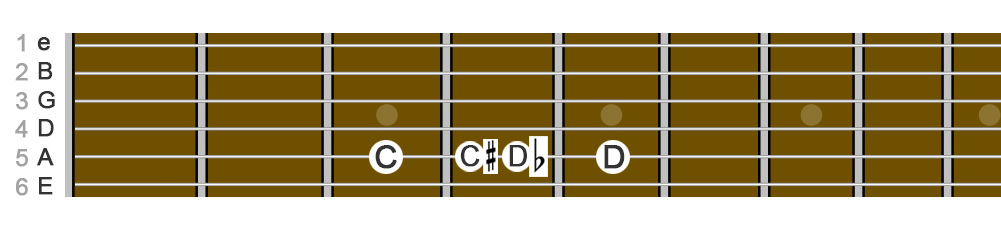
Look at the sharp and flat locations on the fretboard. You will notice that for each sharp note there is a flat note, and each sharp and flat pair both fall on the same fret. This means when they are played they will produce the same note. Two notes that produce the same pitch but have a different note name are known as enharmonic. The following example shows that C sharp and D flat both share the same 5th string 4th fret location. They will both produce the same note when played, and therefore they are enharmonic.
If two notes are exactly the same then why are they written differently? There is good reason for this, as we will learn as our study of music theory progresses. For now, let’s take a look at all of the natural notes and where they are on the fretboard. As a little exercise, map out the locations of all the sharps and flats on those in-between frets.
