
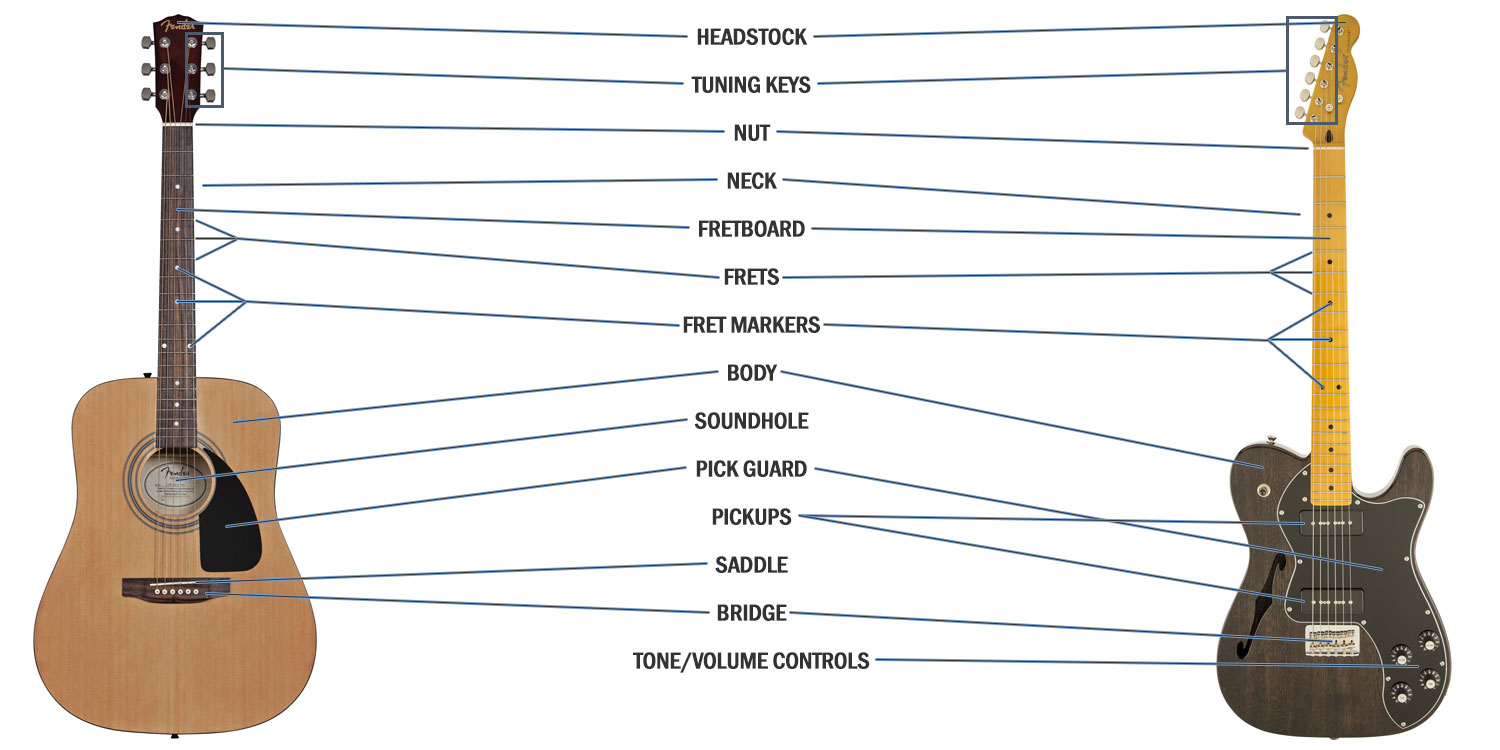
A headstock or peghead is part of a guitar or similar stringed instrument such as a lute, mandolin, banjo, ukulele and others of the lute lineage. The main function of a headstock is to house the pegs or mechanism that holds the strings at the "head" of the instrument. At the "tail" of the instrument the strings are usually held by a tailpiece or bridge. Machine heads on the headstock are commonly used to tune the instrument by adjusting the tension of strings and, consequentially, the pitch of sound they produce.
Tuning Keys (also referred to as a tuning machine, tuner, or gear head) is a geared apparatus for tuning stringed musical instruments by adjusting string tension. Machine heads are used on mandolins, guitars, double basses etc., and are usually located on the instrument's headstock. Some other commonly used slang names for guitar tuners are pegs, gears, machines, cranks, knobs, tensioners and tighteners
A nut, on a stringed musical instrument, is a small piece of hard material that supports the strings at the end closest to the headstock or scroll. The nut marks one end of the vibrating length of each open string, sets the spacing of the strings across the neck, and usually holds the strings at the proper height from the fingerboard. Along with the bridge, the nut defines the vibrating lengths (scale lengths) of the open strings.
The neck is the part of certain string instruments that projects from the main body and is the base of the fingerboard, where the fingers are placed to stop the strings at different pitches. Guitars, banjos, ukuleles, lutes, the violin family, and the mandolin family are examples of instruments which have necks.
The fingerboard (also known as a fretboard on fretted instruments) is an important component of most stringed instruments. It is a thin, long strip of material, usually wood, that is laminated to the front of the neck of an instrument. The strings run over the fingerboard, between the nut and bridge.
A fret is a raised element on the neck of a stringed instrument. Frets usually extend across the full width of the neck. On most modern western fretted instruments, frets are metal strips inserted into the fingerboard. Frets divide the neck into fixed segments at intervals related to a musical framework.
Inlay on guitars or similar fretted instruments are decorative materials set into the wooden surface of the instrument using standard inlay techniques. Although inlay can be done on any part of a guitar, only the positional markers on the fretboard or side of neck serve any function other than decoration. The most popular fret marker scheme involves single inlays on the 3rd, 5th, 7th, 9th, double inlays on the 12th, single inlays on the 15th, 17th, 19th, and 21st, and if present, double inlays on the 24th.
The body design of a guitar can be one of three popular styles. Hollow body, semi-hollow body, and solid body. The acoustic guitar hollow body is chambered to allow the strings to resonate and be heard without amplification. The solid body electric guitar requires amplification to be heard. Semi-hollow body guitars have some chambering, but are not completely hollow.
A sound hole is an opening in the upper sound board of a stringed musical instrument. Though the purpose of sound holes is to help acoustic instruments project their sound more efficiently, the sound does not emanate solely (nor even mostly) from the location of the sound hole. The majority of sound emanates from the surface area of both sounding boards, with sound holes playing a part by allowing the sounding boards to vibrate more freely, and by allowing some of the vibrations which have been set in motion inside the instrument to travel outside the instrument.
A pickup device is a transducer that captures or senses mechanical vibrations produced by musical instruments, particularly stringed instruments such as the electric guitar, and converts them to an electrical signal that is amplified using an instrument amplifier.
A pickguard (also known as scratchplate) is a piece of plastic or other (often laminated) material that is placed on the body of a guitar, mandolin or similar plucked string instrument. The main purpose of the pickguard is to protect the guitar's finish from being scratched by the guitar pick.
The saddle is the small structure against which the strings bear, and through which they conduct their vibrating energy. Saddles are usually made of bone, ivory, or a synthetic material, such as Micarta or Corian, both of which are familiar counter top materials.
A bridge is a device that supports the strings on a stringed musical instrument and transmits the vibration of those strings to some other structural component of the instrument—typically a soundboard, such as the top of a guitar or violin—which transfers the sound to the surrounding air.
The basic function of the volume knob on an electric guitar is to change the level of your guitar’s volume output in a smooth and even way. The tone control can change the tonal characteristic of your sound from bright to warm.